Wednesday, June 26, 2013

A Prince of Persia

Painting.
Period: Mughal Empire, India.
Date: 18th-19th century.
Creation Place: India.
Material and Technique: Ink, opaque watercolor and gold on paper.
Size: 21.5 x 15 cm.
Kept in Harvard Art Museums/Arthur M. Sackler Museum, USA.
Source: [1].

This painting shows a Persian prince in India. I am guessing that he is a member of Afsharid dynasty due to the form of his headgear.

Tuesday, June 18, 2013

Scène D'amour - Safavid Persians Making Love

Painting.
Period: Safavid Era, Iran.
Date: 1692.
Size:  10.3  x 17.4 cm.
Materials and Techniques: Gouache and gold on paper.
Kept in Musées d'art et d'histoire - Ville de Genève (Museum of Art and History, Geneva, Switzerland).
Source: [1].
نقاشی اروتیک صفوی - موزه هنر و تاریخ ژنو - سوئیس
This erotic painting is kept in the Museum of Art and History in Geneva. There are few other interesting items in this museum, which I will post later on. By the middle of the 17th century, erotic art had emerged as a major theme of Persian painting. Bold or hidden, sometimes strange and often humorous, references to the erotic in later Safavid painting and drawing have been understood as expressions of lyrical beauty, metaphors for mystical union, or documents of social realities.

Sunday, June 16, 2013

A Large Portrait of a Qajar Prince - Possibly Abbas Mirza

Painting.
Era: Qajar Period, Persia.
Date: 1800s.
Material and Techniques: Oil on canvas.
Size: 172 by 81.5 cm.
Sold on Sotheby's auction.
Source: [1].

This large portrait is sold on Sotheby's. The work is attributed to Mihr Ali. It is possibly a portrait of Crown Prince Abbas Mirza. One interesting observation about such paintings in this period, is the narrow waist of royal subjects to the extent that they somewhat look feminine.

Monday, June 3, 2013

زنگار زمان

گر چشم را زنگار زمان گرفته است
 لیک گوش دل پر زهوش است
 حکایت چیست که آهنگ وداعیت را
 در دل پخش کرده و خود گوش می دهم
دوباره تکرار می‌کنم
 طنینت را آن‌ عمق صدایت را
 در عمق بی‌نهایت وجود
در موسیقی متن این خاطره ها
غرق در کنایه ام
خسته و نابود از استعاره ها‌ 

Wednesday, May 29, 2013

Alexander the Great and His Men Watching Naked Girls Swim in the Sea of China

Folio.
Era: Unknown Dynasty, Iran.
Date: 1517-1518 AD.
Material and Technique: ink and pigments on laid paper.
Kept in Walters Art Museum, Baltimore, MD, USA.
Sources: [1],[2].

اسکندر در حال تماشای دختران عریان در دریای چین - خمسه نظامی - موزه هنر والترز، آمریکا
This is an illuminated and illustrated Khamsah (quintet) by Niẓāmī Ganjavī (d. 605 AH / 1209 CE), copied by Muḥammad Mūsá al-Mudhahhib ('the Limner') in Safavid Iran in 924 AH / 1518 CE. The manuscript opens with a double-page illustration, which is followed by a double-page illumination. In total, there are six Arabic colophons, one at the end of each of the first four poems and two for the two parts of the final poem (Kitāb-i Sharafnāmah-i Iskandarī and Kitāb-i Iqbālnāmah). The dates of these colophons indicate that the various poems were not executed consecutively. The writing of the text extended over a period of approximately three months, 6 Dhū al-Ḥijjah 923 AH / 1517 CE to 7 Rabīʿ I 924 AH / 1518 CE. The text is written in black nastaʿlīq script with blue subject/section headings. In addition to illuminated title pieces and headpieces, there are twenty-six illustrations. The binding is not original to the manuscript.

Thousand and One Nights (Arabian Nights) - Qajar Period

Painting.
Era: Qajar Period, Persia.
Date: 19th century.
Kept in Imperial Library, Golestan Palace, Tehran, Iran.
Source: Iranian.com.

This miniature is from a copy of the Thousand and One Nights, painted under the direction of Sani ul-Molk Ghafari, who was the official painter at the court of two Qajar Kings: Mohammad Shah, and Nasir Al-Din Shah Qajar.

Treatise on Physical Love - Mughal Empire

Manuscript.
Era: Mughal Empire, India.
Date: 17th century.
Kept in Bibliotheque Nationale, Paris, France.
Source: Iranian.com.

This miniature is from a treatise on physical love with no title or author's name, which was translated from an Indian work by Koka Pandita, the Koka Shastra. In the preface Koka Pandita is described as a vizier of a ruler named Bahram Shah of Delhi, who was said to have a thousand concubines.

According to Wikipedia, the Ratirahasya (Sanskrit रतिरहस्य ) (translated in English as Secrets of Love, also known as the Koka Shastra) is a medieval Indian sex manual written by Kokkoka, a poet, who is variously described as Koka or Koka Pundit. The exact date of its writing is not known, but it is estimated the text was written in the 11th or 12th century. It is speculated that Ratirahasya was written to please a king by the name Venudutta. Kokkoka describes himself in the book as siddha patiya pandita, i.e. "an ingenious man among learned men.The manual was written in Sanskrit. [1]

Two Lovers in a Pavilion

Painting and calligraphy.
Era: Safavid Period, Iran.
Date: 16th-17th century.
Kept in Bibliotheque Nationale, Paris, France.
Source: Iranian.com.

Two lovers in a pavilion. Miniature from a Moraqqa, a collection of models of calligraphy by the best Persian scribes.

Qajar Faience Plaque Showing Shirin Surprised by Khosrow

Faience plaque.
Era: Qajar Peiord, Iran.
Date: 19th century.
Kept in private collection, Tehran, Iran.
Source: Iranian.com.

This items was originally posted in Iranian.com years ago. I have a hard time finding the link. 

Erotic Set of Faience Plaques Showing Women Bathing - Qajar Period

Faience plaque.
Era: Qajar Peiord, Iran.
Date: 19th century.
Kept in private collection, Tehran, Iran.
Source: Iranian.com.

This is another sample of erotic art in Qajar era, which shows two nude ladies taking a bath in a Persian garden.

Dalliance - Safavid Period

Painting.
Era: Safavid Period, Iran.
Date: 17th century.
Kept in Victoria and Albert Museum, London, UK.
Source: Iranian.com.


Two Lovers

Painting
Era: Safavid Period, Iran
Date: 17th century
Formerly Kept in Kevorkian Collection, New York, NY, USA.
Source: Iranian.com

Erotic Qajar Tile Showing European Couple


Tile
Era: Qajar Period, Iran
Date: 19th Century
Kept in a private collection, Tehran, Iran
Source: Iranian.com

This is a facing tile in polychrome faience, which is probably taken from a private bathhouse. It shows a European couple making love.

Erotic Qajar Tile Showing a Persian Couple

Tile
Era: Qajar Period, Iran
Date: 19th Century
Kept in a private collection, Tehran, Iran
Source: Iranian.com

This is a facing tile in polychrome faience, which is probably taken from a private bathhouse. It shows a Persian couple making love.


Winged Man Having Sex With an Animal - Ajayeb Al Makhlukat - Wonders of Creation

Illustration
Era: Possibly Ottoman Empire, Turkey
Date: 17th Century
Kept in Museum of Turkish and Islamic Arts, Istanbul, Turkey.
Source: Iranian.com

This is a miniature illustrating the Ajayeb al-Makhlukat or Wonders of Creation. It possibly belongs to Ottoman Period.

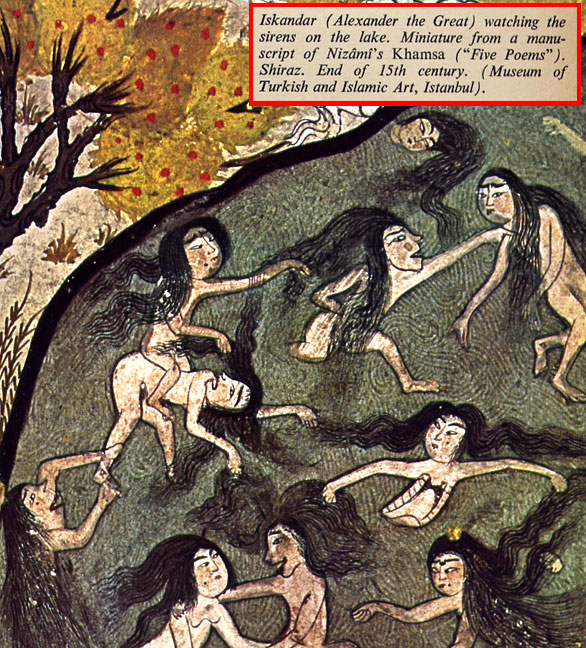
Iskandar Watching the Sirens on the Lake

Manuscript
Era: unknown period, Persia
Date: 15th century
Kept in the Museum of Turkish and Islamic Arts, Istanbul, Turkey
Source: Iranian.com

In this manuscript, Alexander the Great is watching the sirens of the lake, which is a story taken from Nizami's Khamsa (Five Poems). This manuscript was possibly created in Shiraz, Iran.

Erotic Miniature - Ajayeb al Makhlukat - Wonders of Creation

Folio
Era: Possibly Ottoman, Turkey
Date: 17th century
Kept in Museum of Turkish and Islamic Arts, Istanbul, Turkey.
Source: Iranian.com

This is a miniature illustrating the Ajayeb al-Makhlukat or Wonders of Creation. The text has been written in Persian, but it possibly belongs to Ottoman Period.

Khosrow and Shirin's Wedding Night - Timurid Period

Folio
Period: Timurid Dynasty
Date: 15th Century
Kept in Museum of Turkish and Islamic Arts, Istanbul, Turkey
Source: Iranian.com

This folio is about Khosrow and Shirin's wedding night. The miniature is from a manuscript of Nizami's Khamsa "Five Poems." It belongs to Timurid period.

Persian Man Having Sex With a Camel - Jami's Haft Awrang

Folio
Era: Safavid Period, Iran.
Date: 1556-1565
Possibly Kept in Smithsonian Institution, Washington, DC, USA.
Source: Iranian.com

This miniature is about a story in the Silsila al Dhahab (Chains of Gold), the first book of the Haft Awrang (Seven Thrones), by the poet Jami. The manuscript was written by five different scribes at Mashad, Qazvin, and Herat between 1556-1565 for Safavid Ruler Sultan Abul-Fath Ibrahim Mirza.
Jami here tells a story of a  corrupt man who commits bestiality and is berated by Satan. The opening line for example reads: "the wind instrument of music -here the penis- of a depraved man became full of wind/ the howl of his carnal soul reached to the stars." He searches the desert and meadows until he finds a female camel. Since the camel refuses to kneel down, the desperate man ties two wooden supports to her hind legs. " He puts his feet there and crawled up/his 'murdi rig' attained what is desired." Jami uses the word "murdi rig" which literally means "the effects left behind by a dead person;" here it seems to be an allusion to the degree of lust that only a corrupt and thus spiritually dead person is capable of. In the conclusion Satan appears before the man and reproaches him for his treachery, for Satan is worried that those who see this act will curse him. There is a similar item here: [1]

To read more, study Rūmī and The Hermeneutics of Eroticism By Mahdi Tourage.

Khosrow and Shirin's Wedding Night

Folio
Era: Safavid Period, Iran
Date: 16th century
Kept in Museum of Turkish and Islamic Arts, Istanbul, Turkey
Source: Iranian.com

This Folio is about Khosrow and Shirin's wedding night. The miniature is from a manuscript of Nizami's Khamsa (Five Poems). Niẓām ad-Dīn Abū Muḥammad Ilyās ibn-Yūsuf ibn-Zakkī, was a 12th-century Persian poet. Nizāmi is considered the greatest romantic epic poet in Persian literature, [1] who brought a colloquial and realistic style to the Persian epic.

Mihr and Nahid, King Kayvan's Daughter, on Their Wedding Night

Folio
Era: before Safavids, Iran
Date: 1476 AD
Size: H: 8 1/16 x W: 4 3/4 in. (20.5 x 12 cm)
Material and Technique: ink and pigments on laid Persian laid paper
Kept in the Walters Art Museum, located in Baltimore, Maryland, USA
Sources: [1],[2]

This folio from Walters manuscript W.627 contains a miniature depicting Mihr and Nahid, King Kayvan's daughter, on their wedding night. It can be considered somewhat erotic since it belongs to a period which erotic imagery did not exist in Persian manuscripts.

Marriage of Mihr and Nahid

Painting\Folio
Era: Uzbek Period, Central Asia
Location: Bukhara
Date: 16th century
Material and Technique: Opaque watercolor, gold and ink on paper
Size: H: 19.3 W: 12.2 cm
Kept in Smithsonian Institution, Washington DC.
Source: Iranian.com

This painting is a miniature folio about Marriage of Mihr and Nahid from a manuscript called Mihr u Mushtari (The Sun and Jupiter) by the poet Shamsuddin Muhammad 'Assar of Tabriz, which is written in Bukhara in 1523. I was finally able to find this item on Smithsonian's website. There are few similar item in there: [1], [2], [3].


Woman Bathing - Ottoman Period

Painting
Era: Ottoman Period, Turkey
Date: 18th century
Kept in Topkapi Sarayi Library, Istanbul, Turkey.
Source: Iranian.com

This painting shows a nude woman bathing. The miniature was created by Abdullah Bukhari.

Tow Youths Hand in Hand - Safavid Period

Painting
Era: Safavid Period, Persia
Date: 16th century
Kept in Musee Guimet, Paris, France.
Source: Iranian.com

This Safavid painting shows two youths hand in had. It was created sometime at the end of 16th century in Qazvin, Iran. It is now kept in Guimet Museum in France. The Guimet Museum (French: Musée national des Arts asiatiques-Guimet or Musée Guimet) is a museum of Asian art located at 6, place d'Iéna in the 16th arrondissement of Paris, France. It has one of the largest collections of Asian art outside Asia.

Erotic Miniature Paiting in the Reign of Fath Ali Shah Qajar

Painting
Era: Qajar Period, Iran
Date: 19th century
Kept in a private collection in Tehran, Iran.
Source: Iranian.com

This erotic miniature was painted in the reign of Fath Ali Shah or Mohammad Shah Qajar sometime in the second quarter of 19th century, and is kept in a private collection in Tehran.

Monday, May 20, 2013

A Seated Woman With a See Through Dress and a Youth

Drawing
Era: Safavid Period, Iran
Date: 1600 - 1610 AD
Material and Technique: Ink on paper
Size: Height: 12.9 cm Width: 18.0 cm
Kept in the Smithsonian's Museum of Asian Art, Washington DC, USA.
Source: [1]

This is another sample of the Safavid art with an erotic flavor. It portraits of a woman with a see through dress. The young man next to her seems busy pouring wine. The lady's physical expression is in a way that one can assume she says no to more wine.

Nasser al-Din Shah Qajar on The Front Page of The Illustrated London

Magazine
Era: Qajar Period.
Country of Origin: England.
Date: 6 July 1889.
Sources: [1], [2]

The Illustrated London News was the world's first illustrated weekly newspaper; the first issue appeared on Saturday 14 May 1842. It was published weekly until 1971 and then increasingly less frequently until publication ceased in 2003. In here, you see a portrait of Nasser al-Din Shah Qajar on the front page of The Illustrated London News during his last visit to Britain. They are most images which you can view on Iranian.com: [3]

Sunday, May 19, 2013

Ardashir Mirza and Solayman Khan Saham-Al-Doleh Review Their Troops

Painting
Era: Qajar Period, Persia
Date: 1850-1851 AD
Material and Technique: Gouache heightened with gold on paper
Sold at  Christie's Auction
Sources: [1], [2],[3]
اردشیر میرزا رکن الدوله قاجار در حال سان دیدن قشون
This painting is sold on Christie's auction. It portraits Ardashir Mirza reviewing his troops. Prince Ardashir Mirza Rukn al-Dawla (1805/1806-1866) was the ninth son of Crown Prince Abbas Mirza Qajar. He originally served some local governments on behalf of his father. After the death of Fath Ali Shah in 1834, and followed by the revolt of several princes, he became responsible for dealing with Prince Ismail Mirza in Khorasan Province. On his return after his successful campaign in Khorasan, he was appointed the governor of Gorgan and Esterabad for seven years. In 1857, he was given the title of Rukn al-Dawla and was sent to rule Azerbaijan.

During the reign of Naser al-Din Shah, he was appointed as governor of Luristan and Khuzestan in order to end some local disorder at the time. At the end, he became the governor of Mazandaran and Gilan. He was also a poet and his pen name was Agah e Qajar. His poems mostly have romantic themes.

Friday, May 17, 2013

Bowl Inscribed with Sayings of the Prophet Muhammad and 'Ali ibn Abi Talib

Vessel
Era: Samanids Dynasty, Persia.
Date: AH 204-395 / AD 819-1005 - (10th century)
Creation Place: Samarkand, in Modern Uzbekistan
Size: 9.6 x 26.9 cm (3 3/4 x 10 9/16 in.)
Kept in  Harvard Art Museums/Arthur M. Sackler Museum, USA.
Source: [1]

This reddish earthenware is covered in white slip and painted with black (manganese and iron) and red (iron) under clear lead glaze. It is kept in Harvard Art Museum.

Wednesday, May 15, 2013

Qajar Lacquer Papier Mache Panel Depicting a King Climbing a Ladder Aided by Topless Angel in a Night Scene

Panel
Era: Qajar Dynasty, Iran
Date: 19th century
Materials and Technique: Lacquer Papier Mache
Size: 25 x 16 1/2 in (63.5 x 42 cm)
Sold at Christie's auction
Source: [1]

This item is of rectangular form, depicting a night scene with a Shah climbing a ladder aided by a topless angel and an army at his feet. Some Muslim saints are depicted as well on the right corner of this item.

Monday, May 13, 2013

A European Woman Seated Under a Branch, With an Owl

Painting
Era: Safavid Empire, Persia
Creation Date: 1700-1732
Artist: Muhammad Sadiq
Media & Technique: Opaque watercolor and gold on paper
Dimensions: 10 7/16 in. x 7 5/16 in. (26.5 cm x 18.6 cm)
Kept in the San Diego Museum of Art,  San Diego, CA, USA.
Sources: [1],[2]
نقاشی یک زن اروپایی (ملکه آن) - دوره صفوی - موزه هنر سان دیگو , آمریکا
Here is a rare painting from Safavid Iran which displays a European lady dressed in style of Queen Anne of England. The lady in the painting has striking facial similarities with Queen Anne. I am not sure why there is an owl in this painting. This painting is kept in the San Diego Museum of Art in California that houses a broad collection with particular strength in Spanish art. Queen Anne (6 February 1665 – 1 August 1714) ascended the thrones of England, Scotland and Ireland on 8 March 1702. On 1 May 1707, under the Act of Union, two of her realms, the kingdoms of England and Scotland, united as a single sovereign state: the united kingdom of Great Britain. The second image is a portrait of Queen Anne.


Safavid Helmet With a Face Mask

Helmet
Era: Safavid Empire, Persia.
Date: 16th century.
Material and Technique: Engraved Steel.
Kept in The Moscow Kremlin Museum, Russia.
Sources: [1], [2]
کلاهخود فولادی همراه با نقاب - دوره صفوی  - موزه کرملین در مسکو
This helmet is a rare example of Safavid armors. This helmet is beautifully made and the face mask has a nice looking mustache. It was most likely a gift of a Safavid shah to a Russian Tsar. There are three other helmets similar to this one. Two are kept in Russia, and another has private owner. Such helmets have been used in Iran for many years. The main reason for Safavids to seek relations with Russians was to create a an alliance against the Ottoman Turks and to find another route to export Persian silk into Europe. This item was among artifact which were on display at the Smithsonian Institution. For more information Google search "The Tsars and the East: Gifts from Turkey and Iran in The Moscow Kremlin".


Sunday, May 12, 2013

Youth Holding a Candle and an Incense Burner

Painting
Period: Safavid period, Iran
Date: ca. 1640
Material and Technique: Opaque watercolor and gold on paper
Dimensions: 7 3/8 x 4 1/2 inches (18.7 x 11.4 cm)
Kept in the Herbert F. Johnson Museum of Art, Cornell University, NY, USA
Source: [1]
جوان صفوی شمع به دست در حال سوزاندن عنبر - موزه هنر جانسون، دانشگاه کورنل، آمریکا
Persian painting began to shift in the sixteenth century from manuscript illustrations to the predominance of single-page paintings that were compiled into albums. Many of these depicted a solitary figure, or amorous couples standing or sitting alone. The celebrated artist Riza Abbasi (ca. 1565–1635) is considered the great master of this genre. The Johnson Museum’s painting is close in style to the work of his student Muhammad Yusuf al-Husayni.

The idealized youthful figure, whose gender seems ambiguous, wears a hat that suggests he is male. He is shown holding a burning candle and a censer from which thick smoke rises. A slight breeze blows his flowing garments and long, wispy locks of hair. A delicate background pattern of landscape elements and clouds, all painted in gold, creates an otherworldly setting. All of these features characterize the conventionalized images that were so popular during this period. Such depictions have strong poetic connotations, many related to Sufism (Islamic mysticism), that heightened the spiritual content of poetry and contributed new levels of meaning. In this context a painting of a youth could be a metaphor for earthly or divine beauty or love.

Tuesday, May 7, 2013

Possible Elamite Erotic Art

Possibly Another Elamite Artwork. There is a similar item that is claimed to be Elamite which we posted before. Link [1]
Pergamon Museum, Berlin, Germany
Source: Flickr [2]

Terracotta of a Parthian king

Possibly a Parthian king
Pergamon Museum, Berlin, Germany
Source: Flickr [1]

Sunday, April 28, 2013

Qajar Persian Lion and Sun Medal Presented to Dr. Thomas W. Evans

Lion and Sun Medal
Period: Qajar dynasty, Persia
Date: 19th century
Kept in Leon Levy Dental Medicine Library, Philadelphia, PA, USA.
Source: myself :)
مدال درجه سه شیر و خورشید اهدا شده به دکتر ایوانس دندان پزشک آمریکایی توسط شاه قاجار. کتابخانه دندانپزشکی‌ دانشگاه پنسیلونیا، آمریکا
I came across a Lion and Sun medal (#1) studying in Leon Levy Dental Medicine Library at University of Pennsylvania, Philadelphia, USA. Here are few images that I took myself. Dr. Thomas Wiltberger Evans (December 23, 1823 – November 14, 1897) was a dentist who performed dental procedures on many heads of state. He died in Paris, where he had lived for many years, and was buried in Woodlands Cemetery, Philadelphia. In his will, he left money and land for the founding of what was to become the University of Pennsylvania School of Dental Medicine. These medals and decorations, including the Lion and Sun medal, were presented to Dr. Evans for his service. This Qajar service award is a 3rd class Lion and Sun medal according to the note in the library. The note also mentioned that this decoration was founded in 1808 by Fath Ali Shah of Persia. It was awarded to Dr. Evans in June 1868 by the Shah of Persia, which is most likely awarded by Naser al-Din Shah Qajar. Even though there is no record of Dr. Evans traveling to Persia, it is unlikely that he met the Shah during one of  his royal visits to Europe since the date the medal was given does not match the dates that Persian monarch visited Europe. Naser al-Din was the first modern Iranian monarch to visit Europe in 1873 and then again in 1878, and finally in 1889. The museum also includes some some Ottoman medals and decorations.


Friday, April 26, 2013

Portrait of Nasser-ed-Deen, Shah of Iran, 1880s

Historic print
Materials and Technique: engraved print
Date: 1880s
Sold online at Antiqua Print Gallery
Source: [1]


This is image of the Qajar monarch is an authentic historic print which was published at the date stated above. Apparently, the engraver is unknown.

Imperial Order of the Lion and the Sun, Civil Division, IV Class

 Lion and Sun Medal
Period: Qajar dynasty, Persia
Date: possibly 19th century
Size: diameter 69 mm
Source: [1]

Like any other Lion and Sun medallion this bears a polychrome recumbent lion and a radiant sun with a female face. The Order was founded in 1808 by Fath ‘Ali Shah of the Qajar Dynasty as the Royal Order of the Sun. In 1820 it was re-organized and renamed. To learn more about Persian decorations look at this topic on Iranica: [2]

Saturday, April 20, 2013

Layla and Majnun

Painting
Period: Zand or Qajar, Iran
Date: late 18th–second quarter 19th century
Medium: Oil on canvas
Dimensions: 36.5 in. high 33.75 in. wide (90.8 cm high 85.7 cm wide)
Kept in Metropolitan Museum of Art, New York, USA
Sources: [1],[2], [3]
نگاره‌ای از لیلی و مجنون - دوره زند یا قاجار - موزه متروپولیتن نیویورک
This month was so eventful to the extent that I have decided to post a romance related painting to honor what I experienced. I am not too sure, but this painting is either made during Zand or Qajar Dynasty. There are similarities between this work and four other works of Zand period that are kept in Brooklyn Museum: [3],[4], [5], [6]. This painting tells the story of Layla and Majnun, which is a love story from the Middle East, later adopted and popularized by the Persian poet Nizami Ganjavi. It is the third of his five long narrative poems. It is a tragic story of undying love much like the later Romeo and Juliet.

The Zandiyeh (Zand) dynasty was a dynasty led by Karim Khan Zand that ruled southern and central Iran. The beginning of Zand era was of relative peace and economic growth for the country. Some territories that were once captured by the Ottomans in the late Safavid era were retaken, and Iran was once again a coherent and prosperous country. The art of this era is remarkable and, despite the short length of the dynasty, a distinct Zand art had the time to emerge. Many Qajar artistic traits were copied from the Zand examples. Sadly, after the death of the first Zand ruler, the kingdom became unstable until Qajars brought to an end a long period of political instability after collapse of Safavids, reuniting Iranian territory after the disunity and warfare that characterized much of the eighteenth century. This period witnessed a transition from tribal to centralized rule. Iran became entangled in a web of superpower rivalry (between Britain and Russia) and suffered significant losses in the Caucasus. This prompted a program of modernization that resulted in an unprecedented influx of military, technological, and educational innovations from Europe. Artistic innovations in visual arts also followed based on earlier Zand art forms.

Thursday, April 11, 2013

دل اشک ریزان

از غم هجر تو‌ای جان دل ز دستم میرود
 بی‌ تو دگر هیچم، هرچه هستم میرود
 اشک خون ریزم گر به چهره خنده ام
دنیا به سرگیجگی چون که مستم میرود

Sunday, April 7, 2013

قبله و معبود

عشق تو‌ای ساقی‌ مرا مقصود است
دیدن ترا مرا قبله و معبود است
ایام خوش چه آسان برفت و امروز
بزرگ دنیا بی‌ تو مرا محدود است

Friday, April 5, 2013

آهی از عمق وجود

ساقیا در تب تو آتش جان چه خمود است
دل شکسته قامتم گرچه عمود است
مرا دم به دم گر چو نفس برون رود
این تنفس آهی از عمق وجود است

Friday, March 22, 2013

برگ‌های خزان

برگ‌های ریزان
 که با وزش باد از کنار پنجره میگذرند
 برگ‌های پاییزی به رنگ زرد و طلایی
 لبهای ترا تجسم می‌کنم و بوسه‌‌های تابستان را
دستان آفتاب سوخته ترا 
که قدیم‌ها محکم نگه میداشتم

 از وقتی‌ که رفته‌ای 
شبها طولانی تر شده اند
و به زودی صدای غمگین زمستان را خواهم شنید
دلتنگ تو میشوم
   بیش از پیش
 زمانی‌ که برگ‌های خزان میریزند

Sunday, March 17, 2013

Persian Kama Sutra Book Leaf

Manuscript
Era: Mughal Period, India
Date: 19th century
Size: 8 x 4 inches
Sold at liveauctioneers.com
Sources: [1], [2]

Kama Sutra is the ancient India 's racy sex manual. This is another possibly Mughal manuscript written in Persian language. The painting shows the red sky at morning during sunrise while the couple are enjoying themselves at the riverbank. In the Mughal Empire, the Persian language flourished and played a major role in the court affair. Most of the Persians migrated to South Asia to prosper and obtain high positions in Mughal Empire. Many were Sunni Persians who felt discriminated in The Safavid Empire and migrated to mostly Sunni Mughal Empire. There were also rebels and nobles who lost royal favor and migrated to Mughal Empire. The Mughals also preferred to employ foreign Muslim officials that had little or no local interests and thus were loyal to the Mughal emperor. Another reason for emigration of Persian elites to Mughal Empire during the 16-18th centuries was the prosperity of Mughals compared to Safavid Persia.