Showing posts with label Manuscript. Show all posts

Thursday, November 14, 2013

Indo-Persian Homosexual Manuscript

Manuscript.
Era: Mughal Empire or British Raj, India.
Date: 19th century.
Size: 13.2 x 20.3 cm.
Sold on an online auction.
Source: [1].

Northern India under Mughal rule was a haven for gay love. Its icon has to be Mahmud of Ghazni, who deeply loved his boy slave, Ayaz. Their love has become a paragon of ideal love, perhaps analogous to that of Romeo and Juliet in the West. In a telling anecdote, Mahmud asks Ayaz, "who is the most powerful ruler in the world?" "I am the most powerful," Ayaz, the beloved slave replies. The confused king asks his slave boy to explain. "You, Mahmud, are the most powerful of all kings," says Ayaz. "But since I rule your heart, I am more powerful still." In popular lore the two were said to be each other's slave, Ayaz a slave in deed and Mahmud a slave of love. [2]


19th Century Indo-Persian Erotic Illuminated Leaf

Manuscript.
Era: Mughal Empire/ British Raj, India.
Date: 19th century.
Size: 13.2 x 20.3 cm.
Sold on an online auction.
Source: [1].

Since some people take these images without giving any credit to this blog, I have decided to watermark them from now on.

Wednesday, October 2, 2013

Possibly Erotic Persian Manuscript in Sex Museum in Amsterdam

Manuscript.
Era: I am not sure.
Kept in Sex museum Amsterdam, Netherlands.
Source: [1].

I randomly found this image on the Internet. It is on a display in Amsterdam. From the look of it, I think it is written in Persian, but I can't figure out the period that it was made.

Wednesday, May 29, 2013

Alexander the Great and His Men Watching Naked Girls Swim in the Sea of China

Folio.
Era: Unknown Dynasty, Iran.
Date: 1517-1518 AD.
Material and Technique: ink and pigments on laid paper.
Kept in Walters Art Museum, Baltimore, MD, USA.
Sources: [1],[2].

اسکندر در حال تماشای دختران عریان در دریای چین - خمسه نظامی - موزه هنر والترز، آمریکا
This is an illuminated and illustrated Khamsah (quintet) by Niẓāmī Ganjavī (d. 605 AH / 1209 CE), copied by Muḥammad Mūsá al-Mudhahhib ('the Limner') in Safavid Iran in 924 AH / 1518 CE. The manuscript opens with a double-page illustration, which is followed by a double-page illumination. In total, there are six Arabic colophons, one at the end of each of the first four poems and two for the two parts of the final poem (Kitāb-i Sharafnāmah-i Iskandarī and Kitāb-i Iqbālnāmah). The dates of these colophons indicate that the various poems were not executed consecutively. The writing of the text extended over a period of approximately three months, 6 Dhū al-Ḥijjah 923 AH / 1517 CE to 7 Rabīʿ I 924 AH / 1518 CE. The text is written in black nastaʿlīq script with blue subject/section headings. In addition to illuminated title pieces and headpieces, there are twenty-six illustrations. The binding is not original to the manuscript.

Treatise on Physical Love - Mughal Empire

Manuscript.
Era: Mughal Empire, India.
Date: 17th century.
Kept in Bibliotheque Nationale, Paris, France.
Source: Iranian.com.

This miniature is from a treatise on physical love with no title or author's name, which was translated from an Indian work by Koka Pandita, the Koka Shastra. In the preface Koka Pandita is described as a vizier of a ruler named Bahram Shah of Delhi, who was said to have a thousand concubines.

According to Wikipedia, the Ratirahasya (Sanskrit रतिरहस्य ) (translated in English as Secrets of Love, also known as the Koka Shastra) is a medieval Indian sex manual written by Kokkoka, a poet, who is variously described as Koka or Koka Pundit. The exact date of its writing is not known, but it is estimated the text was written in the 11th or 12th century. It is speculated that Ratirahasya was written to please a king by the name Venudutta. Kokkoka describes himself in the book as siddha patiya pandita, i.e. "an ingenious man among learned men.The manual was written in Sanskrit. [1]

Two Lovers in a Pavilion

Painting and calligraphy.
Era: Safavid Period, Iran.
Date: 16th-17th century.
Kept in Bibliotheque Nationale, Paris, France.
Source: Iranian.com.

Two lovers in a pavilion. Miniature from a Moraqqa, a collection of models of calligraphy by the best Persian scribes.

Winged Man Having Sex With an Animal - Ajayeb Al Makhlukat - Wonders of Creation

Illustration
Era: Possibly Ottoman Empire, Turkey
Date: 17th Century
Kept in Museum of Turkish and Islamic Arts, Istanbul, Turkey.
Source: Iranian.com

This is a miniature illustrating the Ajayeb al-Makhlukat or Wonders of Creation. It possibly belongs to Ottoman Period.

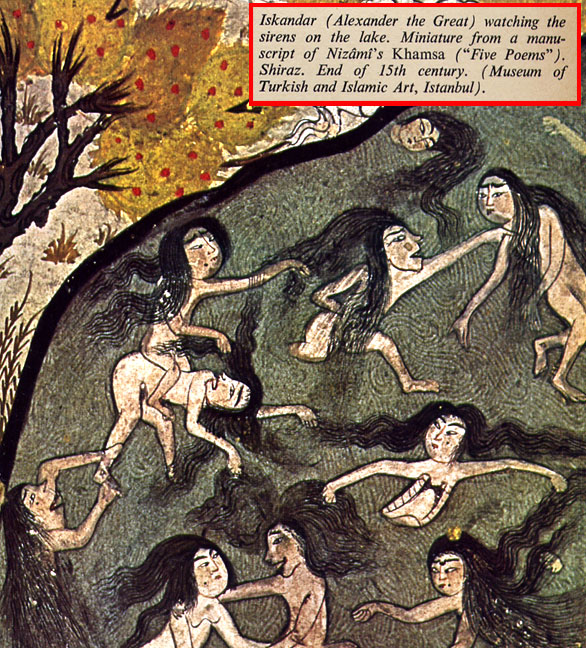
Iskandar Watching the Sirens on the Lake

Manuscript
Era: unknown period, Persia
Date: 15th century
Kept in the Museum of Turkish and Islamic Arts, Istanbul, Turkey
Source: Iranian.com

In this manuscript, Alexander the Great is watching the sirens of the lake, which is a story taken from Nizami's Khamsa (Five Poems). This manuscript was possibly created in Shiraz, Iran.

Erotic Miniature - Ajayeb al Makhlukat - Wonders of Creation

Folio
Era: Possibly Ottoman, Turkey
Date: 17th century
Kept in Museum of Turkish and Islamic Arts, Istanbul, Turkey.
Source: Iranian.com

This is a miniature illustrating the Ajayeb al-Makhlukat or Wonders of Creation. The text has been written in Persian, but it possibly belongs to Ottoman Period.

Khosrow and Shirin's Wedding Night - Timurid Period

Folio
Period: Timurid Dynasty
Date: 15th Century
Kept in Museum of Turkish and Islamic Arts, Istanbul, Turkey
Source: Iranian.com

This folio is about Khosrow and Shirin's wedding night. The miniature is from a manuscript of Nizami's Khamsa "Five Poems." It belongs to Timurid period.

Persian Man Having Sex With a Camel - Jami's Haft Awrang

Folio
Era: Safavid Period, Iran.
Date: 1556-1565
Possibly Kept in Smithsonian Institution, Washington, DC, USA.
Source: Iranian.com

This miniature is about a story in the Silsila al Dhahab (Chains of Gold), the first book of the Haft Awrang (Seven Thrones), by the poet Jami. The manuscript was written by five different scribes at Mashad, Qazvin, and Herat between 1556-1565 for Safavid Ruler Sultan Abul-Fath Ibrahim Mirza.
Jami here tells a story of a  corrupt man who commits bestiality and is berated by Satan. The opening line for example reads: "the wind instrument of music -here the penis- of a depraved man became full of wind/ the howl of his carnal soul reached to the stars." He searches the desert and meadows until he finds a female camel. Since the camel refuses to kneel down, the desperate man ties two wooden supports to her hind legs. " He puts his feet there and crawled up/his 'murdi rig' attained what is desired." Jami uses the word "murdi rig" which literally means "the effects left behind by a dead person;" here it seems to be an allusion to the degree of lust that only a corrupt and thus spiritually dead person is capable of. In the conclusion Satan appears before the man and reproaches him for his treachery, for Satan is worried that those who see this act will curse him. There is a similar item here: [1]

To read more, study Rūmī and The Hermeneutics of Eroticism By Mahdi Tourage.

Khosrow and Shirin's Wedding Night

Folio
Era: Safavid Period, Iran
Date: 16th century
Kept in Museum of Turkish and Islamic Arts, Istanbul, Turkey
Source: Iranian.com

This Folio is about Khosrow and Shirin's wedding night. The miniature is from a manuscript of Nizami's Khamsa (Five Poems). Niẓām ad-Dīn Abū Muḥammad Ilyās ibn-Yūsuf ibn-Zakkī, was a 12th-century Persian poet. Nizāmi is considered the greatest romantic epic poet in Persian literature, [1] who brought a colloquial and realistic style to the Persian epic.

Mihr and Nahid, King Kayvan's Daughter, on Their Wedding Night

Folio
Era: before Safavids, Iran
Date: 1476 AD
Size: H: 8 1/16 x W: 4 3/4 in. (20.5 x 12 cm)
Material and Technique: ink and pigments on laid Persian laid paper
Kept in the Walters Art Museum, located in Baltimore, Maryland, USA
Sources: [1],[2]

This folio from Walters manuscript W.627 contains a miniature depicting Mihr and Nahid, King Kayvan's daughter, on their wedding night. It can be considered somewhat erotic since it belongs to a period which erotic imagery did not exist in Persian manuscripts.

Marriage of Mihr and Nahid

Painting\Folio
Era: Uzbek Period, Central Asia
Location: Bukhara
Date: 16th century
Material and Technique: Opaque watercolor, gold and ink on paper
Size: H: 19.3 W: 12.2 cm
Kept in Smithsonian Institution, Washington DC.
Source: Iranian.com

This painting is a miniature folio about Marriage of Mihr and Nahid from a manuscript called Mihr u Mushtari (The Sun and Jupiter) by the poet Shamsuddin Muhammad 'Assar of Tabriz, which is written in Bukhara in 1523. I was finally able to find this item on Smithsonian's website. There are few similar item in there: [1], [2], [3].


Sunday, March 17, 2013

Persian Kama Sutra Book Leaf

Manuscript
Era: Mughal Period, India
Date: 19th century
Size: 8 x 4 inches
Sold at liveauctioneers.com
Sources: [1], [2]

Kama Sutra is the ancient India 's racy sex manual. This is another possibly Mughal manuscript written in Persian language. The painting shows the red sky at morning during sunrise while the couple are enjoying themselves at the riverbank. In the Mughal Empire, the Persian language flourished and played a major role in the court affair. Most of the Persians migrated to South Asia to prosper and obtain high positions in Mughal Empire. Many were Sunni Persians who felt discriminated in The Safavid Empire and migrated to mostly Sunni Mughal Empire. There were also rebels and nobles who lost royal favor and migrated to Mughal Empire. The Mughals also preferred to employ foreign Muslim officials that had little or no local interests and thus were loyal to the Mughal emperor. Another reason for emigration of Persian elites to Mughal Empire during the 16-18th centuries was the prosperity of Mughals compared to Safavid Persia.

Sunday, February 3, 2013

Legendary Keyumar Depicted as a Qajar Infantryman

Illustration and Painting
Era: Qajar Period, Persia
Materials and Techniques: Watercolor and ink on paper.
Date: circa 1820
Size: 29.7 x 20.7 cm
Kept in British Museum, London, UK
Source: [1]
کیومرث در لباس سرباز قاجار - موزه بریتانیا
The mythological first Man in old Iranian culture and the legendary King Keyumar [2] (or Gayomard or Gayomart) the first king of the world according to Shahnameh [3] is seen here dressed as a Qajar infantry man. He kneels facing the viewer, holding a sword in one hand and a shield in the other. In the period of Fath Ali Shah much of the imagery of Ancient Iran was revived. Paintings of the legendary kings, such as Keyumars, who ruled over a world without war, were produced for inclusion in albums rather than as manuscript illustrations. There is similar item here: [4]

Saturday, February 2, 2013

Safavid Man With a Pitchfork

Painting in a Manuscript
Era: Safavid Period, Persia
Date: July 11, 1634 (4 Safar, A.H. 1044)
Materials and Techniques: Album Painting, Ink and color washes on paper.
Size: Inner: 4 1/2 x 2 3/8 in. (11.0 x 6.0 cm)
kept in Los Angeles County Museum of Art (LACMA)
The Nasli M. Heeramaneck Collection, gift of Joan Palevsky.
Source [1]
نقاشی مرد صفوی و چنگک - موزه لوس آنجلس
This painting is a page from an album which was created by Riza Abbasi (or Reza Abbasi, Iran, Isfahan, died 1635) who was a leading Persian miniaturist of the Isfahan School during the Safavid period, spending most of his career working for Shah Abbas I. For more information about Riza Abbasi, you can read on Wikipedia: [2]

Sunday, January 27, 2013

Mozaffar ad-Din Shah Qajar in Le Petit Journal

Newspaper
Date: 19th century
Country: France
Source: [1]

تصاویر مظفر الدین شاه قاجار در مجله یا روزنامه فرانسوی - قرن ۱۹ میلادی
Le Petit Journal was a daily Parisian newspaper published from 1863 to 1944. It was founded by Moïse Polydore Millaud. In the 1890s, at the height of its popularity, the newspaper had a circulation of a million copies, and by 1884 it also included a weekly illustrated supplement.

The two top images include a portrait of Mozaffaradin Shah Qajar before his coronation and his visit to Contrexeville France is illustrated in the Petit Journal. The image bellow, shows the much aged monarch.

You may also click on link [2] to look at another post about cartoon drawing of the same Persian monarch in Le Rire magazine.

Wednesday, January 9, 2013

Bahram Gur With a Princess

Illustration
Qajar era, Persia
Date: second half of the 19th Century
Size: 23.6 x 13.5 cm
Sold at Bonham's auction
Source: [1]
نگاره بهرام گور و یک شاهزاده خانم - دوره قاجار - حراجی بونامز
This illustrated leaf is from a manuscript of Persian poetry depicting Bahram Gur with a princess seated in green and white pavilions. The Persian text is written in columns of Nasta'liq script in black ink. As most Qajar illustrations, the old king is pictured dressed in contemporary of Qajar era. To learn more about Nasta'liq script click here: [2]

Wednesday, August 29, 2012

A Set of Eleven Persian Illuminated Manuscript Leaves

each with one side containing a geometric decorated field and gilt pigment, the reverse having painted erotic scenes.
Height 8 7/8 x width 5 1/4 inches.
Possibly Qajar Period
Source: Leslie Hindman Auctioneers