

Showing posts with label Money. Show all posts
Showing posts with label Money. Show all posts
Wednesday, February 11, 2015
Future of Apple

Tuesday, February 10, 2015
TD bank and Iranian students

Thursday, October 10, 2013
Group Portrait of The Staff of The Imperial Bank of Persia

Era: Qajar Period, Persia.
Date: 1890-1891.
Dimensions: 16 x 20.9 cm.
Kept in the Tropenmuseum, Amsterdam, the Netherlands.
Source: [1]
I found this image online on the website. The description was in Dutch saying "Groepsportret met het personeel van de Imperial Bank of Persia, Teheran" which can be translated as Group portrait of the staff members of the Imperial Bank of Persia, Tehran, Persia. According to Wikipedia, the Tropenmuseum (meaning Museum of the Tropics) is an anthropological museum located in Amsterdam, the Netherlands. It has been established in 1864.
Wednesday, March 13, 2013
Qajar 20 Tomans Banknote

Period: Qajar Era, Iran
Value: 20 Tomans
Source: [1]
This is another Qajar banknote. There are few more in Wikipedia as seen on the second link. [2] As you see, the English name of Iran is stated Persia in all Persian Banknotes.
Sunday, February 17, 2013
Imperial Bank Note of Persia - 10 Tomans

Era: Qajar dynasty
Date: 20th century
Face value: ten Tomans
Sold on ebay
Source: [1]
The date is somewhat interesting on this bank note. Qajar dynasty was overthrown in 1925, but this bill has stamp date of 1930!

Tuesday, February 5, 2013
Qajar Era Currency Bill

Era: Qajar Period, Persia
Date: 1896
Face value: One Toman
Sources: [1], [2]
اسکناس یک تومانی قاجار
In 1888 an English-owned New Oriental Bank established branches in Tehran and other cities, and for the first time Persians became acquainted with a bank in the modern sense. In 1889, Baron Julius de Reuter obtained from Nāṣer-al-Dīn Shah the concession of establishing the Imperial Bank of Persia and the monopoly of issuing bank notes in Persia. To read more click on this link: [3]. The Image below also shows two other types of Persian bank notes in Qajar era. Apparently, each bank note was payable in certain city within Iran.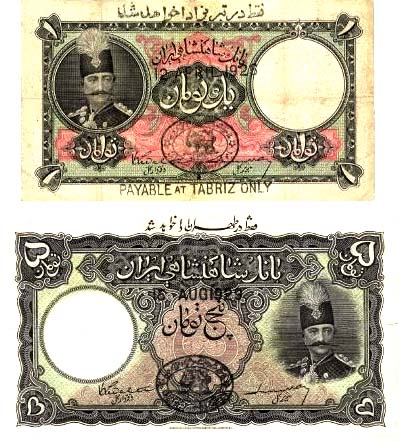
Silver Coin of Nadir Shah Afshar

Era: Afsharid Dynasty, Persia
Date: 1736-1747
Material: Silver
Weight: 11.51 grams
Kept in British Museum, London, UK
Source: [1]
Afshars (1736-1796) were a Persian Dynasty led by chieftain Nadir who was crowned Nadir Shah in 1736. This coin was minted in during his reign.
Gold Coin of Shahrukh Afshar

Era: Afsharid Dynasty, Persia
Date: 1755-1796
Material: Gold
Weight: 10.69 grams
Kept in British Museum
Source: [1]
This is a gold coin of Shahrukh Shah Afshar, (Persian: شاهرخ) who was the last king of the Afsharid Dynasty. In 1796, Agha Muhammad Khan Qajar conquered Khorasan and had Shahrukh tortured to death because he thought Shahrukh knew of Nadir's treasures.
Silver Coin of Shahrukh Afshar

Era: Afsharid Dynasty, Persia
Date: 1748-1749
Material: Silver
Weight: 22.34 grams
Kept in British Museum
Source: [1]
This is a silver coin of Shahrukh Shah Afshar, (Persian: شاهرخ) who was a king of the Afsharid dynasty and a contemporary of the Zand kings.
Monday, January 28, 2013
Naser al-Din Shah's One Gheran Coin

Era: Qajar Period, Persia
Date: 19th Century
Value: One Gheran, or 20 Shahi or 1000 Dinar
Sources: [1], [2], [3], [4]
سکه یک قرانی ناصرالدین شاه قاجار با نقش عقاب دو سر
The double-headed eagle is a rare example of the symbols used in Qajar coins. It is common symbol in heraldry and vexillology. It is most commonly associated with the Byzantine Empire, the Holy Roman Empire, the Russian Empire and their successor states. In Byzantine heraldry, the heads represent the dual sovereignty of the Emperor (secular and religious) and/or dominance of the Byzantine Emperors over both East and West. In the Holy Roman Empire's heraldry, it represented the church and the state. Several Eastern European nations adopted it from the Byzantines and continue to use it as their national symbol to this day. The images bellow are the coat of arms of the Holly Roman Empire of The German People, and the coat of arms of the Russian Empire.

Friday, October 5, 2012
Nasir al-Din Shah Coin or Medallion

Era: Qajar Dynasty, Persia.
Date: 19th Century.
Owner: sold on an online auction
Source: [1]

Tuesday, October 2, 2012
Gold Coin of Mozaffar ad-Din Shah

Qajar Dynasty, Iran
Date: Late 19th Century
No information about the owner.
Source: [1]
سکه دوره مظفرالدین شاه قاجار
On the coin, there is uniformed bust of the Shah wearing a hat with an aigrette and abundantly festooned with Orders and Decorations. On the reverse side, within a circle, Persian legend: al-Sultan al-`Azam wa’l Khaqan al-Afkhim Muzaffar al-din Shah Qajar, 10 Toman value below, ornaments around in outer border with small mint name Tehran at top. This coin was likely struck in conjunction with his formal enthronement. The face value of this coin is 10 Tomans.According to Wikipedia, Toman is a superunit of the official currency of Iran, the Rial. Toman, derived from a Mongolian word meaning ten thousand (see tumen), was the currency of Iran until 1932. It was divided into 10,000 Dinar. Between 1798 and 1825, the Toman was also subdivided into 8 rial, each of 1250 Dinar. In 1825, the Qiran was introduced, worth 1000 Dinar or one tenth of a Toman. In 1932, the Rial replaced the Toman at a rate of 1 Toman = 10 Rials (i.e., 1 rial = 1 qiran). Although the Rial is the official currency of Iran, many Iranians employ the term Toman in everyday transactions for an amount of 10 Rials. In unofficial circumstances, a Toman may also refer to either 1,000 Tomans or 1,000,000 Tomans. The order of the magnitude of the amount would be considered to be apparent from the context. - Wikipedia [2]
Friday, September 14, 2012
Coin of Shah Suleiman I of Safavid Dynasty

Safavid Period
During the time of Shah Suleiman I
Kept in the David Collection, Copenhagen, Denmark
Source: [1]

Shah Suleiman I ,[2], was a Safavid monarch who reigned between 1666 and 1694 AD. He was the elder son of the Shah Abbas II. The young ruler had been raised in the harem and had no experience of the world outside. He was also addicted to alcohol and suffered from poor health.
According to Wikipedia, the David Collection is a museum of fine and applied art in Copenhagen, Denmark. It was built around the private collections of C.L. David, who was a lawyer, businessman and art collector. The museum is noted for its collection of Islamic art from the 8th to the 19th century, which is one of the largest in Northern Europe.
Subscribe to:
Posts (Atom)